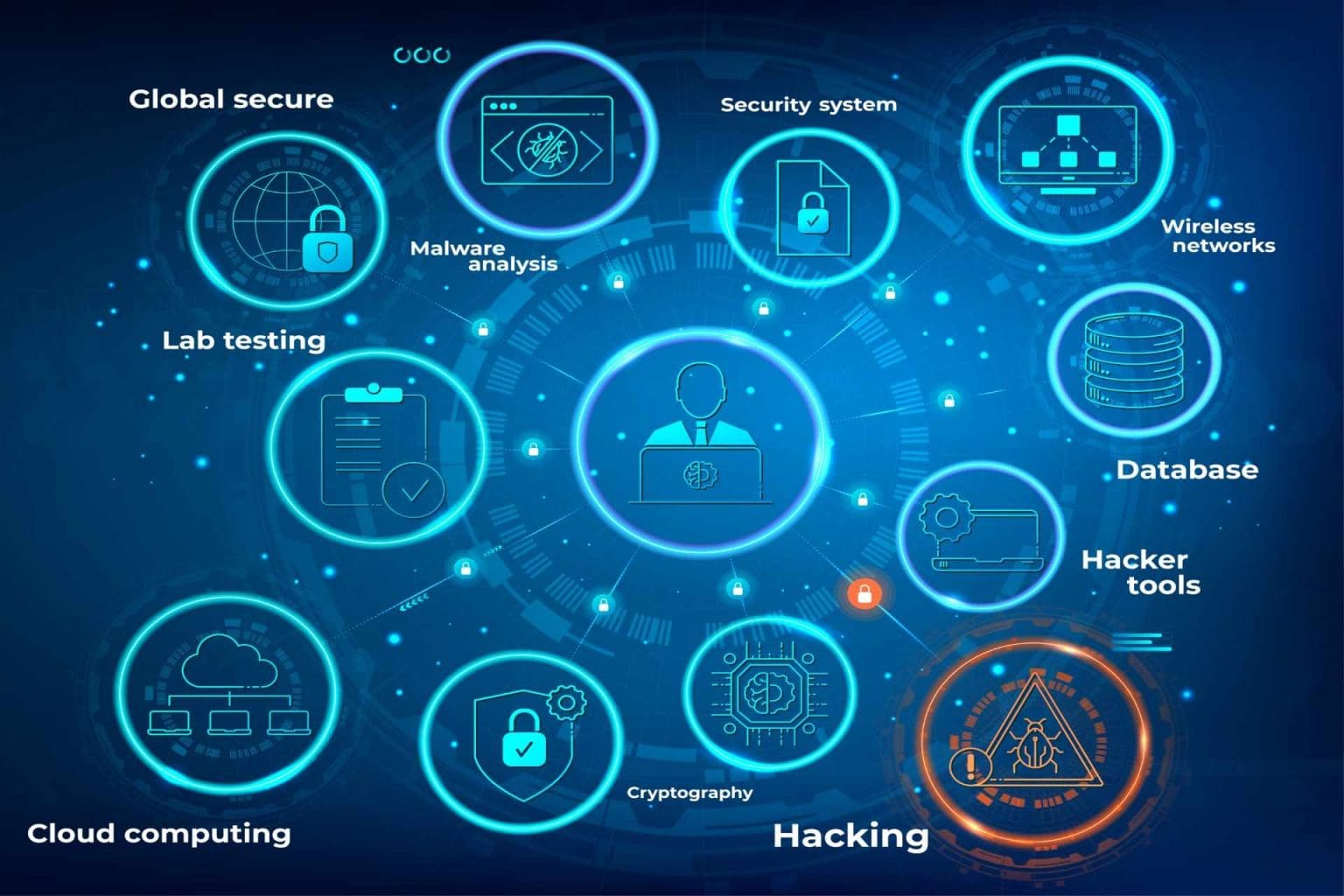
Artificial intelligence is changing the way organizations approach cybersecurity. Security teams now have to monitor cloud environments, applications, endpoints, identity systems, and large volumes of security events while attackers continue to develop faster and more sophisticated techniques.
AI is becoming part of this environment by helping security professionals analyze information, identify suspicious behavior, automate selected tasks, and support incident investigations.
For students and aspiring cybersecurity professionals in Perinthalmanna, as well as those from Malappuram and nearby Palakkad areas, understanding AI in cybersecurity in Perinthalmanna can provide useful insight into how cybersecurity careers are evolving.
Where Does AI Fit Into Cybersecurity?
AI is not a replacement for firewalls, endpoint protection, access controls, vulnerability management, or other established security measures.
Instead, it can add another layer of analysis.
Security environments produce large quantities of information. A human analyst may not be able to manually review every event, particularly when an organization has thousands of endpoints, users, applications, and network connections.
These systems can help identify patterns across this information and bring unusual activity to the attention of security professionals.
This makes AI particularly valuable in environments where speed and scale matter.
Key Ways AI Is Used by Security Teams
The role of AI in cybersecurity can be seen across several different activities.
• Security Monitoring
These systems can analyze security events and identify behavior that differs from established patterns.
For example, an account that suddenly accesses unfamiliar systems or an endpoint that begins communicating with unexpected destinations may trigger additional investigation.
They can help prioritize such events so analysts can focus on activity that appears more significant.
• Threat and Anomaly Detection
Machine learning can be used to identify patterns associated with suspicious behavior.
This can complement conventional security systems that rely on signatures or predefined rules.
The objective is not to assume every unusual event is an attack. Instead, AI can help security teams identify events that deserve further examination.
• Phishing Analysis
AI is increasingly relevant to both phishing attacks and phishing defense.
Attackers can use generative AI to produce convincing messages and adapt them to different audiences. Microsoft’s 2025 Digital Defense Report identified AI-automated phishing among the techniques being used by threat actors.
Defenders can use these tools to analyze email content, URLs, communication patterns, and other indicators that may suggest a phishing attempt.
• Incident Investigation
During a security incident, analysts may need to review information from multiple systems.
Generative AI can help summarize alerts, explain technical information, search through security data, and organize findings.
However, security teams should verify AI-generated conclusions before acting on them. AI can misunderstand context or provide incorrect information, especially when the available data is incomplete.
A Simple Example of AI-Assisted Threat Detection
Consider a company employee who normally works with a specific set of applications and accesses company systems during predictable hours.
Suddenly, the account begins attempting unusual logins and accessing resources that are not normally associated with that user.
An AI-assisted security platform can compare this behavior with previous patterns and flag the activity for investigation.
The alert itself does not confirm an attack. The security analyst needs to investigate whether the behavior resulted from legitimate activity, a compromised account, or another cause.
This combination of automated analysis and human investigation is one of the practical ways AI is being integrated into cybersecurity.
AI and Cybersecurity Opportunities in Perinthalmanna
Perinthalmanna serves as an important educational and commercial centre in the Malappuram region. Students from the town, surrounding areas of Malappuram, and nearby parts of Palakkad can consider cybersecurity as a technology career with multiple areas of specialization.
Modern cybersecurity is not limited to penetration testing.
Career paths can include:
- Security Operations Center roles
- Penetration testing
- Cloud security
- Vulnerability management
- Incident response
- Digital forensics
- Threat intelligence
- Security automation
These technologies are increasingly becoming relevant across these areas.
For students interested in AI cybersecurity in Perinthalmanna, learning how AI supports security operations can complement practical cybersecurity knowledge and help them understand the direction of the industry.
Why AI Skills Matter Across Malappuram and Palakkad
The increasing use of AI means cybersecurity professionals need to understand two related questions:
How can AI help defend systems?
and
How can AI create new security risks?
Learning both sides is important.
A cybersecurity professional may encounter AI-assisted threat detection in a SOC environment, AI-supported vulnerability analysis, automated security workflows, or applications that use large language models.
At the same time, those systems may introduce risks that need to be identified and managed.
NIST’s Cyber AI Profile work reflects this broader approach by examining AI from three perspectives: securing AI components, using AI for cyber defense, and addressing AI-enabled attacks.
Security Risks Created by AI
AI has introduced new security challenges alongside its defensive benefits.
Generative AI can help attackers produce phishing and social-engineering content more efficiently. AI applications themselves can also be exposed to vulnerabilities.
OWASP’s 2025 LLM security guidance includes risks such as prompt injection, sensitive information disclosure, supply-chain weaknesses, data and model poisoning, excessive agency, and misinformation.
These risks are particularly important when AI systems are connected to business data, internal applications, or external tools.
An AI system with excessive permissions can potentially create a much larger security problem than a standalone chatbot. This is why access control, least privilege, monitoring, validation, and secure design remain important even when AI is involved.
AI Skills for the Next Generation of Cybersecurity Professionals
Cybersecurity professionals do not need to become AI researchers to benefit from these developments.
They can start by understanding practical areas such as:
- How machine learning supports threat detection
- How generative AI can assist security operations
- How attackers use these technologies for phishing and social engineering
- LLM security fundamentals
- Prompt injection and AI application risks
- AI-assisted security automation
- How to validate AI-generated findings
- The limitations of AI-based security tools
These skills should complement, rather than replace, fundamental cybersecurity knowledge.
Networking, Linux, web security, penetration testing, cloud security, vulnerability assessment, and incident response remain important foundations.
The Future of AI in Cybersecurity
The future of AI in cybersecurity is likely to involve more automation and greater interaction between AI systems and security tools.
Generative AI assistants can already help analysts summarize information and support investigations. More capable AI agents may perform selected actions through connected tools.
But greater automation also means organizations must carefully control permissions and monitor what AI systems are doing.
NIST’s 2026 AI work continues to examine trustworthy AI and the security considerations surrounding AI-enabled capabilities, including agentic AI environments.
This suggests that future cybersecurity professionals will need to understand both traditional security architecture and the security implications of increasingly autonomous AI systems.
Building an AI-Ready Cybersecurity Foundation in Perinthalmanna
For students in Perinthalmanna, Malappuram, and nearby Palakkad areas, developing an AI-ready cybersecurity skill set should begin with practical fundamentals.
Understanding networks, operating systems, Linux, web applications, vulnerabilities, penetration testing, cloud environments, and security operations provides the foundation for working with real cybersecurity environments.
Once these fundamentals are established, knowledge of AI can be layered onto them to understand how security teams are adopting automation, intelligent analysis, and other emerging capabilities.
Learners looking to strengthen these practical foundations can explore ethical hacking courses in Perinthalmanna offered by RedTeam Hacker Academy, where hands-on training in areas such as penetration testing, network security, web application security, and vulnerability assessment can provide a practical foundation for understanding how emerging technologies are shaping cybersecurity.
Conclusion
AI is becoming an important part of modern cybersecurity. It can help security teams analyze large amounts of information, identify unusual activity, support threat detection, and automate parts of security operations.
But AI does not eliminate the need for skilled cybersecurity professionals. Human judgment, strong security controls, appropriate access management, and careful validation remain essential.
For students and professionals in Perinthalmanna, Malappuram, and nearby Palakkad areas, understanding AI in cybersecurity in Perinthalmanna means preparing for a security landscape where artificial intelligence will increasingly be part of both defensive technologies and emerging threats.